.svg)
.svg)

.png)

.png)
.png)

Copyright © 2024 Expat Home Finders. All Rights Reserved.


Guaranteed response within one business day.
.png)
Living
Resettling
Moving to the Netherlands with children adds a whole new layer of complexity to an already demanding process. While single professionals and couples can be flexible about where they land, families usually need to get two big decisions right at the same time: choosing the right school and finding the right home. Get the sequence wrong, or make them independently of each other, and you can end up with a long commute, a stressful school application, or worse, a home you love that's nowhere near your child's school.
This guide walks you through what you need to know: the international school landscape across the Randstad, what schools actually cost in 2026/27, how long the waitlists are, how to align your home search with your school choice, and what to prioritize in a family rental.
This is the single most important piece of advice we can give families. In the Dutch expat housing market homes move fast, sometimes within 24 hours of listing. But international school places can take weeks or months to confirm, and some schools have waitlists stretching 6–12 months or longer.
If you find your ideal home first and then discover that the school you had in mind has no places available, or is 45 minutes away by car, you're in a difficult position. The right sequence is:
Even if you don't have a confirmed place yet, many schools will give you enough information about likely timelines to allow you to start planning your housing search intelligently.
This is the question we hear most, and the answer depends on eligibility. Dutch International Schools are partly funded by the Dutch government, which is why their fees are so much lower. They are primarily intended for families with an international background who are in the Netherlands temporarily. Schools ask you to demonstrate that need, and the exact rules vary by school, so check admissions criteria early. Some schools also give priority to certain groups of applicants.
If you are an EU citizen relocating long term, the Dutch national system, including Dutch bilingual and international streams at regular schools, may also be worth considering. Your children are entitled to education in the Netherlands, and Dutch primary and secondary schooling is publicly funded, with only a voluntary parental contribution (ouderbijdrage). Registration with your municipality and a citizen service number (BSN) come first.
The Netherlands has a strong international school network, concentrated in the Randstad. Fees below are annual tuition. Where we have confirmed 2026/27 figures from the school, we say so. Other figures are 2025/26 and are rising by roughly 4–5% a year at subsidized schools, so always confirm with the school.


Popular international schools, particularly ISA in Amstelveen and the British School of Amsterdam, are heavily oversubscribed. It is not uncommon for families to wait 6–12 months for a confirmed place, and some have waited longer.
Government-subsidised international schools (like AICS, Amity, ISU, and RISS) are considerably more affordable but also face high demand from expat families precisely because of their lower fee structure. Applying to multiple schools simultaneously is a sensible strategy.
A few practical notes on the application process:
The key takeaway: start your school applications as early as possible, ideally 6–12 months before your planned arrival date.
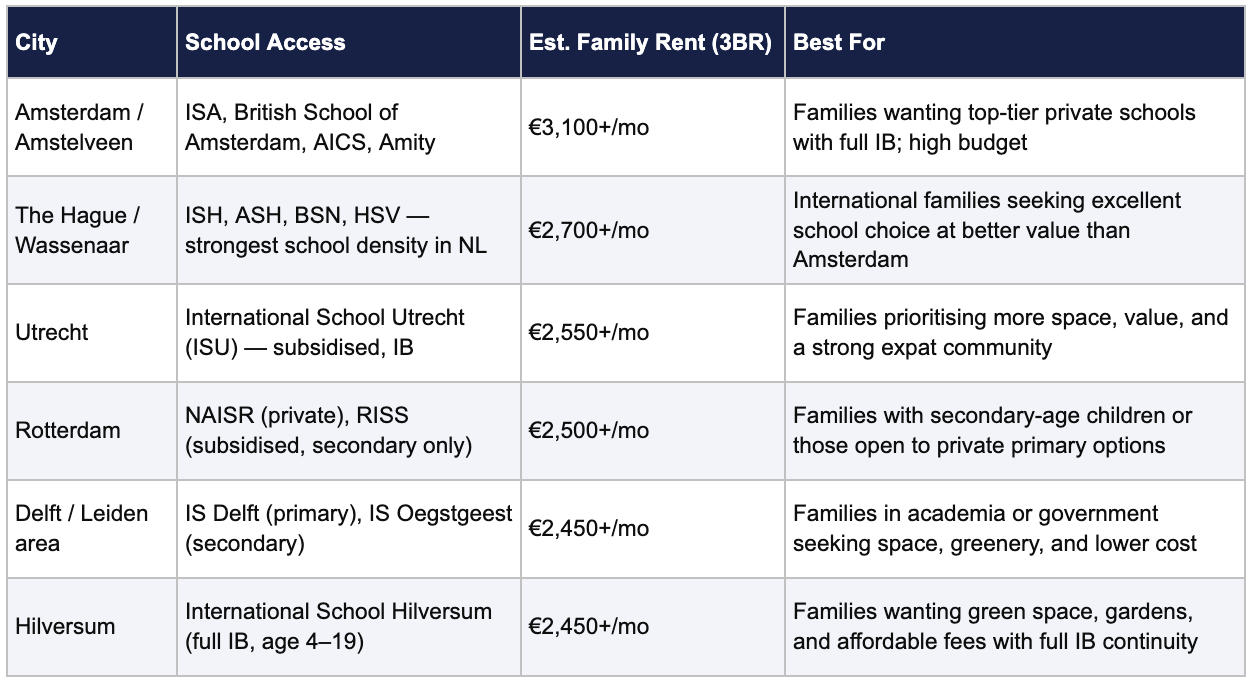
Once you have a confirmed school (or a strong shortlist), use the school's location as the anchor for your home search. Here's a practical framework:
The 30-Minute Rule: Most expat families treat a 30-minute door-to-door commute to school as the maximum. The Dutch cycling culture means that for primary school children, a 10–15 minute bike ride is genuinely feasible and extremely common. For older children using public transport, 30 minutes is a comfortable upper limit. This radius opens up more options than many families realise. ISA in Amstelveen, for example, is accessible from Amsterdam South, Amstelveen, Haarlem, and parts of Diemen within 30 minutes. The British School in the Netherlands (BSN) near The Hague is reachable from Wassenaar, Leidschendam, Rijswijk, and central Den Haag.
Think About Secondary School Too: If your children are in primary school now, it's worth thinking about secondary school access too, particularly if you plan to stay in the Netherlands for several years. Most international primary schools have natural feeder routes into partner secondary schools. Check that your chosen neighbourhood keeps both within reach.
Supply in the Dutch private rental sector keeps shrinking. According to Pararius, investors sold over 65,000 rental homes in 2025 while buying only about 27,000, a net loss of roughly 38,000 rentals in one year, and more listings left its platform than were added in Q1 2026. Rent regulation introduced in 2024 for the mid-priced segment has contributed to landlords selling up.
The practical consequences for families: competition is highest in Amsterdam, Utrecht, Rotterdam and The Hague, and the pressure has spread to once-affordable nearby towns. The market peaks in late summer, when corporate relocations and students coincide, and again in early spring. Looking slightly beyond the obvious neighborhoods, within your 30- minute radius, often widens your options considerably.
Space: The Netherlands is not known for large homes, and Dutch square meterage can feel modest compared to what families are used to in the US, UK, or Australia. For a family with two or more children, a minimum of 100–120m² (about 1,075–1,290 sq ft) is a reasonable benchmark, with three bedrooms as a baseline. Furnished homes can be harder to find at family-appropriate sizes, so many families opt for unfurnished or shell and invest in their own furniture.
Outdoor Space: A private garden (tuin, what Americans call a yard) is high on most family wish lists and harder to find in city centers. In Amsterdam, a private garden sharply narrows supply and raises the price. In Utrecht, Rotterdam, The Hague and outer neighborhoods, garden homes are more accessible. If a garden matters, be ready to adjust your city, your budget, or both.
Neighbourhood: The Netherlands is generally a very safe country, and neighbourhood safety is rarely the concern for expat families that it might be in other markets. What matters more practically is cycle-friendliness, proximity to green space, and access to supermarkets and family-oriented amenities. Areas with high expat density, such as Oud-Zuid in Amsterdam, Wassenaar near The Hague, or Leidsche Rijn in Utrecht, tend to have established international communities, which can make the transition easier for children and parents alike.
School Transport: Check whether your preferred school offers a bus service or is easily accessible by public transport. ISA in Amstelveen, for instance, is well-served by trams and buses from Amsterdam. BSN operates a bus service across The Hague area. Understanding the school run logistics before committing to a home can save considerable daily stress.
Many families underestimate the combined weight of rent and school fees. At the premium end the numbers are large. Two primary-age children at ISA cost about €55,000 a year in tuition alone (roughly €4,600 a month, or about $5,300). Add €3,500 a month in rent and you are at around €8,000 a month (about $9,100) before utilities, groceries and transport.
Subsidized schools change the equation. At roughly €4,500–€9,000 per child per year, they bring an international education to a fraction of the private price. For families whose employer is not covering school fees, they are worth serious consideration, subject to eligibility.
If your employer pays: If you are moving for work, ask whether your employer will contribute to school fees. Under the Dutch 30% ruling for qualifying expats, employers can in some cases reimburse the costs of international schooling tax-free as extraterritorial costs. The ruling's rate is scheduled to change from 2027, and eligibility depends on your situation, so speak to a tax adviser before relying on it.
At Expat Home Finders, we work with families every week navigating exactly this challenge. Whether you need a three-bedroom with a garden near ISA, or a spacious family home within easy reach of The Hague's international school cluster, we'll find it.
Ready? → Click "Let's Get Started" Today
Sources: International School ofAmsterdam: fees 2026–27. International School Eindhoven: school fees 2026–27. IamExpat: school fees in the Netherlands (updated January 2026). Pararius: understanding the Dutch rental crisis as an expat in 2026. CBS: housing rents up by an average of 4.4 percent (July 2026). International School Advisor: Amsterdam and The Hague 2026 cost guides.
Let's Get Started

Guaranteed response within one business day.
Stay connected in this current market with our monthly newsletter.
Copyright © 2024 Expat Home Finders. All Rights Reserved.

.svg)
Ensuring a personalized experience with accompanied viewings.
Included Services:

Searches
Contract Review
Offer Submission
Accompanied Viewings
Scheduled Viewings
Accompanied Check-in
Fee: Equal to 1 month’s listed rental price + 21% VAT, on a no cure no pay basis.
.webp)

