





Copyright © 2024 Expat Home Finders. All Rights Reserved.


Guaranteed response within one business day.
Renting
Market
Amsterdam is not one housing market. It's a dozen of them. The rent you'll pay, the type of property you'll find, who your neighbours will be, and how quickly you'll need to move when something comes up all vary enormously depending on which neighbourhood you're targeting. Two streets can mean a difference of €400 per month.
This guide breaks down where expats are actually renting in Amsterdam, not just the tourist-facing fantasy version of the city, but an honest look at what each neighbourhood offers, what it costs, and which expat profiles tend to gravitate there. We've grounded our analysis in the latest rental market data from Pararius, combining publicly available listing information with our own hands-on experience in the Amsterdam rental market to ensure the figures reflect current market conditions.
Use this table as your quick reference before diving into each neighbourhood in detail below.
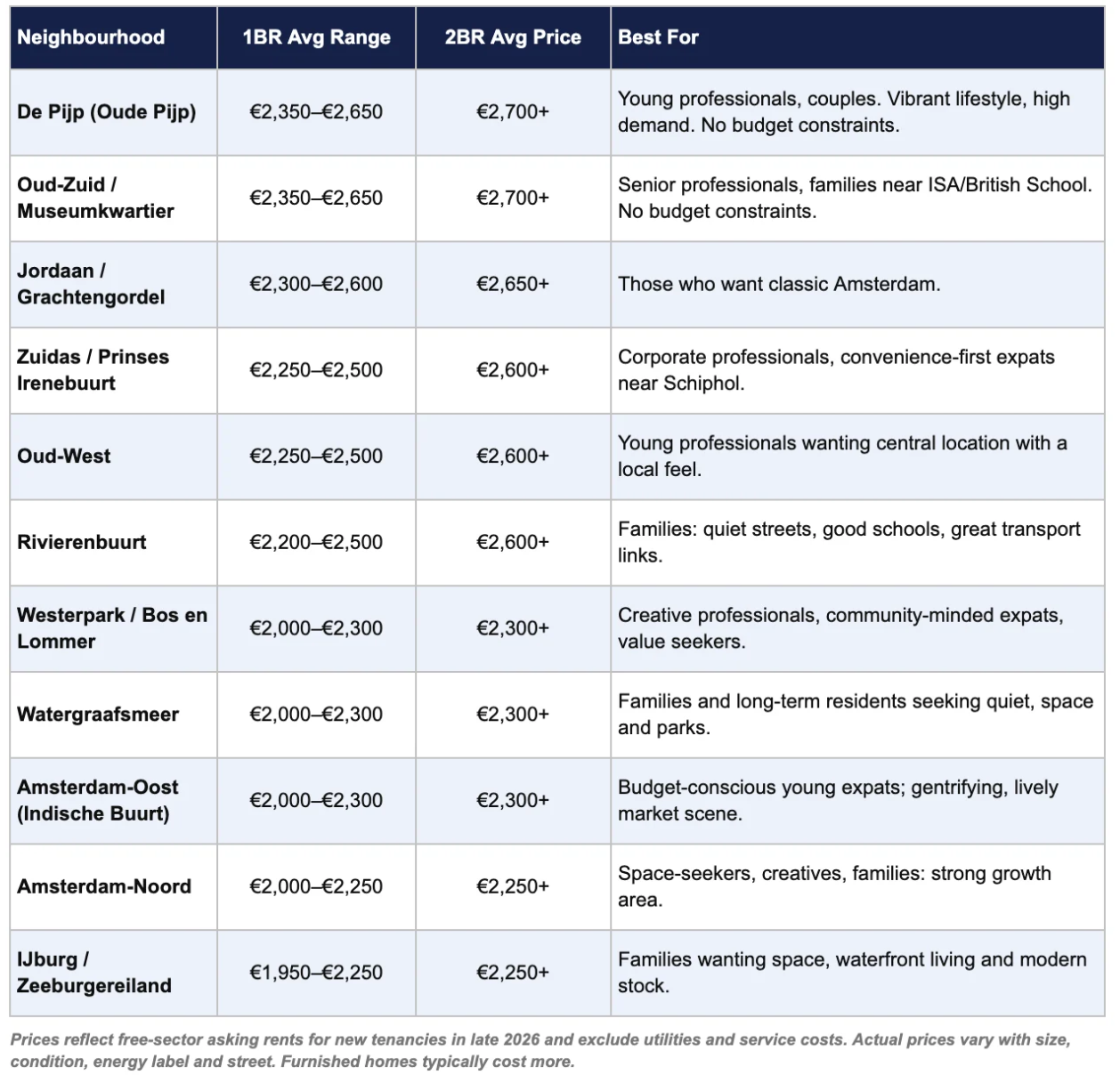
Here is what you actually need to know about each area: the character, the trade-offs, and who it suits best.
Budget level: Premium | Best for: Young professionals and couples who want vibrant street life, great food, and a genuinely international community
De Pijp is arguably Amsterdam's most popular expat neighbourhood and not just because of the food scene, though the Albert Cuyp Market and Ferdinand Bolstraat make a compelling case. It has the density of daily life that makes a neighbourhood feel alive: coffee shops, wine bars, Indonesian restaurants, multicultural supermarkets, and Sarphatipark for weekends.
Oude Pijp (the northern section) is the most desirable and most expensive. It consistently records the lowest vacancy rates in Amsterdam with listing agents reporting properties gone within 24 to 48 hours. The North-South metro line (Line 52) connects De Pijp to Centraal Station in minutes and runs down to Zuidas, making it almost uniquely convenient.
A word of context: parts of Nieuwe Pijp (the southern section, near Van Woustraat) have a rougher edge. It's not a safety concern by any international standard, but it's a noticeable step down in feel from Oude Pijp. Know which sub-section your listing is in before committing.
Budget level: Premium | Best for: Senior expats on corporate packages, families near ISA and BSA, those who prioritise green space and prestige
Amsterdam-Zuid is the city's most prestigious district, and Oud-Zuid, anchored by Vondelpark and the Museumplein, is its crown jewel. The architecture here is grander than the canal belt: wide tree-lined streets, larger apartments, and the kind of neighbourhood where you'll find established international professionals and long-term expat families.
Proximity is Oud-Zuid's trump card for families. ISA in Amstelveen is a short tram or cycle ride. The British School of Amsterdam is accessible. Vondelpark is on the doorstep for weekends. Concertgebouwbuurt and Apollobuurt within the district are particularly sought-after by expats who want the full Amsterdam lifestyle package at the top tier.
Prices are high and stock is limited, but unlike De Pijp or the Jordaan, you're more likely to find larger, family-appropriate apartments of 100m²+ here. Furnished options are relatively common, given the high concentration of corporate relocations.
Budget level: Premium | Best for: Senior professionals, established expats, anyone who simply wants the most beautiful setting in the city
The Jordaan is what most people picture when they imagine Amsterdam. Narrow 17th-century canal houses, cobblestoned bridges, boutique shops, brown cafés, and an impossibly photogenic streetscape. It's genuinely beautiful. Prices here reflect both the lifestyle premium and the severe scarcity of available rentals. Canal house apartments are rare to market, often requiring agents with private landlord relationships to access.
The Grachtengordel (Canal Belt) sits adjacent and shares the same price tier. Apartments here tend to be older, characterful, and (true to Dutch form) steep-staircased and sometimes quirky in layout. The payoff is living in a UNESCO World Heritage site with everything within a 10-minute cycle.
One practical note: tourist density is high during summer months in the Jordaan core, and noise can be a factor on certain streets. The quieter western Jordaan around Westerstraat tends to attract longer-term expat residents who want the character without the worst of the crowds.
Budget level: High | Best for: Corporate expats working in the financial or legal sector, families wanting walkable access to international schools
Zuidas is Amsterdam's financial and legal district. Home to the Dutch Stock Exchange, major law firms, and the Dutch headquarters of companies including ABN AMRO, ING, and Deloitte. If you're relocating for a corporate role, there is a strong chance your office is here or nearby, which makes it the most purely convenient choice for many expats.
Zuidas and Prinses Irenebuurt as having the strongest long-term rental demand growth in 2026, driven by transit access (Station Zuid connects to Schiphol in under 10 minutes), the ongoing development of new residential towers, and proximity to ISA in Amstelveen. The area has evolved from a purely commercial zone into a genuine mixed-use neighbourhood with restaurants, gyms, and supermarkets in recent years, though it still lacks the raw character of older Amsterdam districts.
The residential offering around Zuidas is dominated by modern, well-insulated apartments, a practical contrast to the charming-but-drafty canal houses of the Jordaan. Combined with strong demand from international professionals, this makes Zuidas one of Amsterdam’s fastest-moving rental markets.
Budget level: High-Mid | Best for: Young professionals, remote workers, and expats who want a local Amsterdam feel without the tourist pricing of the canal belt
The municipality of Amsterdam once declared Oud-West home to the 'happiest people in Amsterdam' and it's easy to see why. Sharing a direct border with the centre, it has the Foodhallen (Amsterdam's best covered food market), easy cycling to both Vondelpark and Jordaan, a restaurant-dense Kinkerstraat, and a streetscape that feels genuinely local rather than curated for visitors.
Oud-West is getting more expensive and demand from young professionals and expat couples continues to push rents upward. Grand Apartments notes steady, growing interest in Oud-West from longer-term expat residents who want neighbourhood stability over nightlife proximity; a shift in who's renting here compared to even three years ago.
Budget level: Mid | Best for: Expat families seeking safety, space, good schools, and a lower price than Oud-Zuid with excellent transport
Rivierenbuurt is Amsterdam's under-the-radar family neighbourhood, and one of the most highly rated areas among local residents. It sits south of De Pijp, running alongside the Amstel river with tree-lined streets, wide boulevards, well-maintained buildings, and a noticeably quieter atmosphere than the districts to the north.
Families with school-age children in particular gravitate here. Amstel station provides direct metro and train connections to Zuidas, Schiphol, and Centraal. Several highly regarded Dutch primary schools are located within the neighbourhood, and ISA in Amstelveen is accessible by tram. The neighbourhood character has historically been quieter and more residential and that stability is a significant draw for families.
Rents are notably more reasonable despite a central location, which makes Rivierenbuurt one of the best value propositions in the city for families.
Budget level: Mid | Best for: Families and established expats planning to stay 2+ years who want quiet, green space, and genuine neighbourhood life
Watergraafsmeer is one of those Amsterdam neighbourhoods that expats discover after they've been in the city for a while and often wonder why they didn't look there first. It doesn't have the Instagram appeal of the Jordaan or the buzz of De Pijp, but it offers what longer-term residents value most: space, Park Frankendael on the doorstep, genuinely residential streets, and a friendly neighbourhood feel.
Watergraafsmeer ranks among the most desirable areas for families and established professionals, which is a category that is notably separate from the expat-first areas like De Pijp and Oud-West. Grand Apartments also flags it as one of the neighbourhoods seeing increasing interest from longer-term expat renters looking for stability rather than novelty. Rents remain meaningfully lower than the headline Amsterdam districts despite good transport links into the centre.
Budget level: Mid-Affordable | Best for: Creative professionals, remote workers, and families wanting more space, gardens, and a distinct city character at lower prices
Amsterdam-Noord has undergone a genuine transformation over the past decade. The free IJ ferry from Centraal Station (running every few minutes, bikes welcome) connects Noord to the city centre in under 5 minutes, and a metro line now serves the area too. What was once a remote working-class district has become one of the city's most creative and dynamic areas, anchored by the NDSM-wharf arts and culture complex.
What makes Noord increasingly attractive to expats is the combination of more space, lower rents, and genuine neighbourhood character. Gardens and family homes are more accessible here. Noord holds a strong expected rental demand growth, precisely because it offers the space and value that the southern districts can no longer provide. It remains one of Amsterdam's best-kept secrets for incoming expats.
Budget level: Affordable | Best for: Families wanting genuine space, modern housing stock, and outdoor lifestyle without the premium of central Amsterdam
IJburg is Amsterdam's youngest neighbourhood (purpose-built on artificial islands in the IJmeer since the late 1990s) and it shows. The housing stock is modern, well-insulated, spacious, and family-oriented in a way that older Amsterdam simply isn't. You'll find proper family houses with gardens, playgrounds on every block, a neighbourhood beach, and watersports facilities right outside your front door.
The trade-off is distance. IJburg sits at Amsterdam's eastern edge, and while a tram line (Line 26) connects it to Centraal Station, the journey takes around 20–25 minutes. For families who work remotely, or who commute once or twice a week, this is entirely manageable, and the payoff in terms of space and quiet is significant. IJburg is one of the most affordable options in Amsterdam proper.
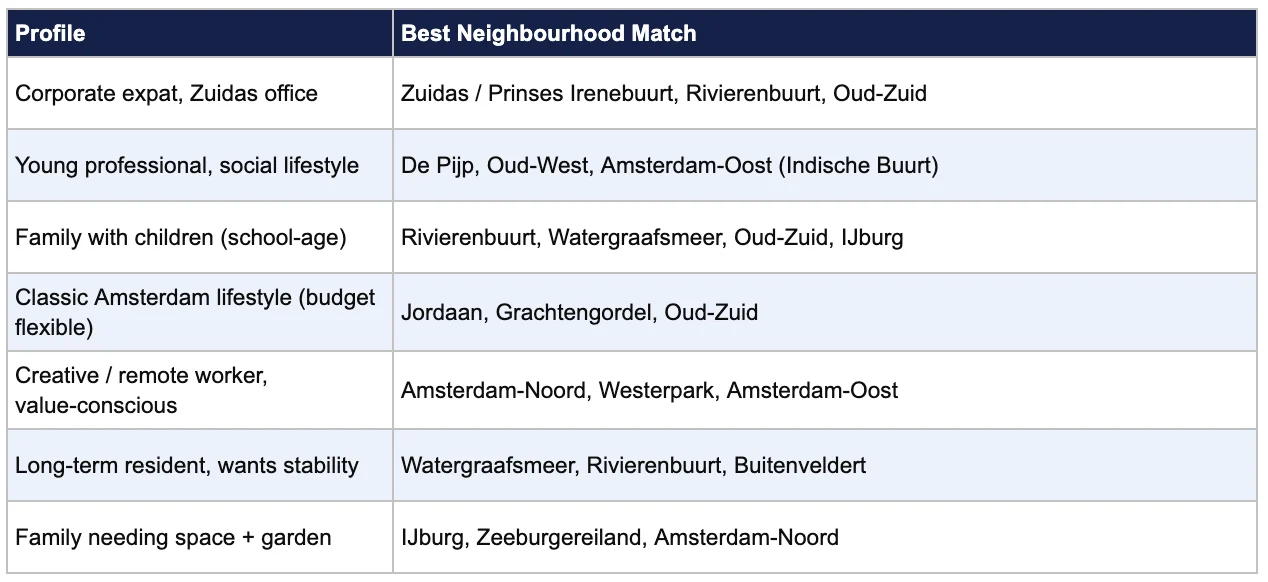
Here's a quick-reference summary based on different expat profiles:
Knowing which neighbourhood suits you is one thing, but finding an available, well-priced home there is another. The average Amsterdam listing receives over 50+ enquiries. The families and professionals who secure the best homes do so because they move fast, present strong applications, and in many cases have access to off-market listings that never appear on Pararius or Funda.
At Expat Home Finders, helping internationals find and secure rental homes in Amsterdam is what we do every day. With in-depth knowledge of Amsterdam’s rental market, neighbourhood by neighbourhood, and established connections with local property agents, we help expats navigate the competitive Amsterdam housing market and find the right home.
We work on a no cure, no pay basis, meaning you only pay our agency fee once we successfully secure a rental property for you. For clients looking to secure an apartment remotely from abroad before arriving in The Netherlands, an initial €499 deposit is required to get started. This deposit is fully deducted from your final invoice once we successfully secure your new home.
Ready? → Click "Let's Get Started" Today
Sources: Pararius Rental Report | To provide a more accurate picture, we combined publicly available rental listing data with our own experience in the Amsterdam rental market.
Let's Get Started

Guaranteed response within one business day.
Stay connected in this current market with our monthly newsletter.
Copyright © 2024 Expat Home Finders. All Rights Reserved.


Ensuring a personalized experience with accompanied viewings.
Included Services:

Searches
Contract Review
Offer Submission
Accompanied Viewings
Scheduled Viewings
Accompanied Check-in
Fee: Equal to 1 month’s listed rental price + 21% VAT, on a no cure no pay basis.


